CHOOSE THE MODE YOU CAN SUSTAIN
GMAT Online vs Physical Classes in Nepal
Compare how each class format delivers live explanation, feedback, practice review and continuity around your location and schedule.
Discuss your GMAT plan Open the MKS GMAT app
Fact-checked: 24 September 2026 · Nepal student and parent guide · Official GMAC sources

The scale is context, not a promise. Build evidence, feedback and a sustainable routine.
GMAT preparation · MKS Education
GMAT Online vs Physical Classes in
Quick answer: Online and physical GMAT classes should teach the same current exam, use official-format practice and provide a traceable diagnosis-practice-review cycle. Physical classes can support routine, direct interaction and a controlled classroom, but travel and fixed timing can reduce consistency. Online classes can serve students outside Kathmandu and working applicants, but they require stable technology, active participation and reliable live teacher access. Hybrid study can combine classroom contact with remote continuity. Before enrolling, verify who teaches Quantitative Reasoning, Verbal Reasoning and Data Insights, whether online lessons are live, whether recordings are available in every mode, how assignments and mock reviews work, and how long app, book and teacher support continues. The best mode is the one that produces regular attended lessons, completed practice, reviewed errors and realistic full simulations—not the one with the strongest sales label.
Delivery mode should protect the learning loop
Online and physical GMAT classes are comparable only when teaching feedback practice and access are defined clearly
Location changes how students attend, but it does not change the current GMAT content or the need for independent correction.
Keep the exam standard constant. The current GMAT has three 45-minute sections: 21 Quantitative Reasoning questions, 23 Verbal Reasoning questions and 20 Data Insights questions. Physical and online courses should both teach the same current question families, no-calculator Quant boundary, Data Insights calculator use, section-order decision and Question Review & Edit workflow. A delivery format is not valuable if the syllabus is obsolete, official practice is missing or feedback never reaches the student.
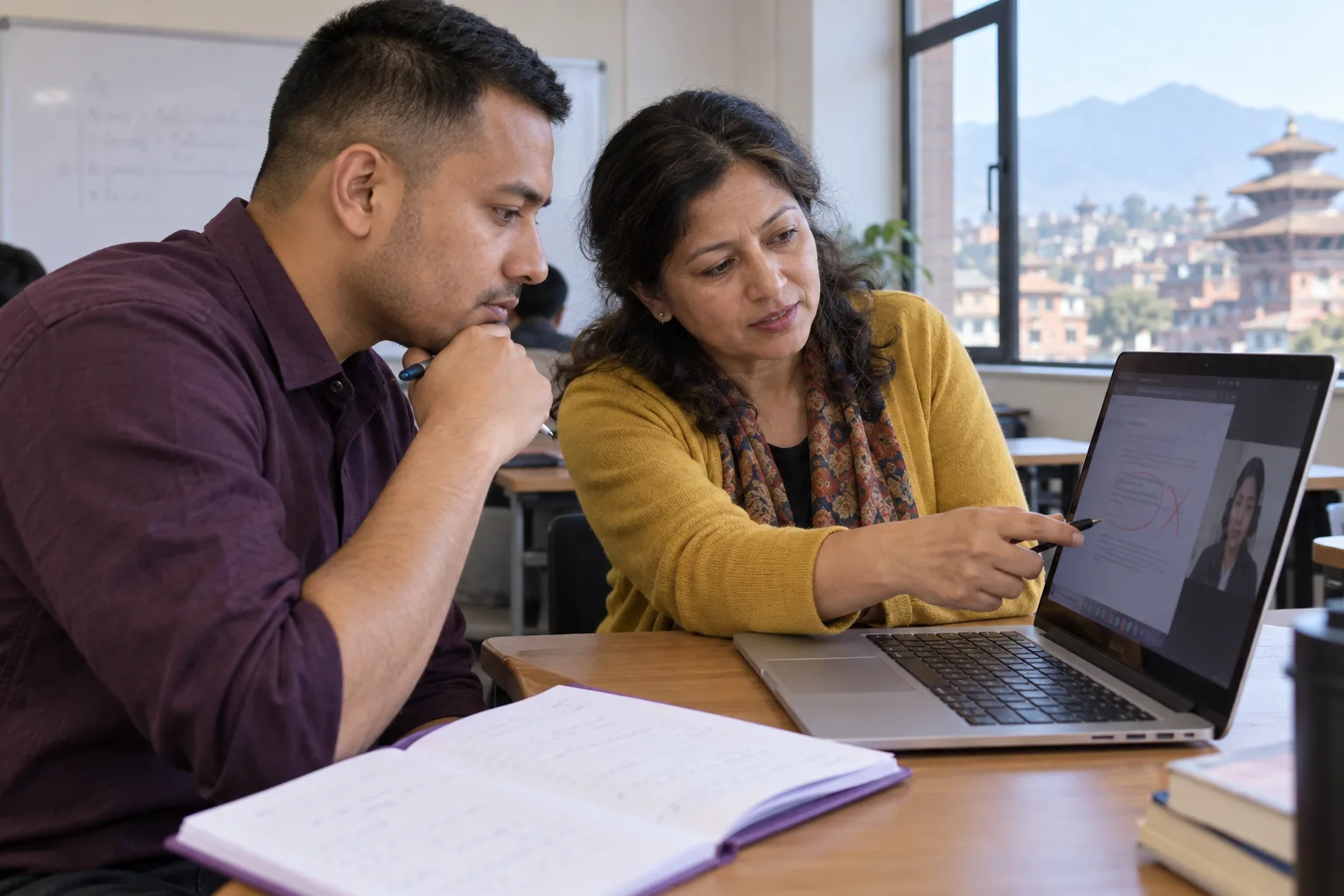
Physical classes can create a fixed routine and immediate face-to-face interaction. Students may find it easier to ask a follow-up question, annotate physical books and complete supervised computer practice. The centre can control room distractions and demonstrate complex Quant or Data Insights work on a shared display. However, calculate commute, transport disruption, college or office conflicts and the cost of missing one lesson. Ask whether a physical student receives a recording and a catch-up pathway rather than losing the full topic.
Online classes remove location and travel barriers and can support students across Nepal or professionals studying after work. Quality depends on live teaching, clear audio and visuals, structured participation, teacher questions, assignment feedback and a suitable home device. A video library alone is not the same as a live class. Test the learning platform before enrolling, confirm how diagrams and tables are displayed, and ask what happens during a connection failure. Recordings should lead to fresh practice and teacher review rather than passive rewatching.
Hybrid preparation is useful when it has clear rules. A student may attend key explanations and full mocks physically while joining revision or catch-up sessions online. Another may begin online outside Kathmandu and switch temporarily during a visit. Confirm whether the same teacher, syllabus, assignments and progress record continue across modes. Ask about batch capacity, advance notice, recording access and whether mode changes affect the fee or support period. Flexibility without academic continuity can fragment preparation.
Compare evidence rather than promises. Attend a trial discussion, inspect an actual Quant, Verbal or Data Insights explanation, and ask to see a reviewed error log and mock feedback example. Verify official mba.com resources in the study plan. Get the guided weeks, timetable, class size, recordings, app access, physical books, mock workflow, support end date and repeat-class terms in writing. Reassess the chosen mode after a checkpoint using attendance, completed practice, fresh accuracy, timing and explanation quality.
MKS Education offers physical, online and hybrid GMAT classes in Kathmandu. Recordings are provided in every mode, alongside iOS and Android app practice, physical books and teacher feedback. The guided course runs for eight weeks with six-month access and continued support. Students needing another suitable explanation may join suitable repeat classes without another class charge, subject to current schedules and seats. MKS does not guarantee a GMAT score, admission, scholarship, assistantship or funding.
Diagnose first
Use a current official-format baseline and classify Quant Verbal and Data Insights errors before choosing weekly priorities.
Match the goal
Connect the test date and preparation schedule to official programme and scholarship deadlines.
Verify claims
Use mba.com and official business-school pages for changing format, fees, dates and score-use policies.
Swipe horizontally to compare every column.
Evidence table
Turn the comparison into checks you can verify
Use the same questions for every provider and save the written answer. A transparent system is easier to compare than a headline promise.
| Check | Why it matters | What to verify |
|---|---|---|
| Current syllabus | Must be identical across modes. | Quant Verbal and Data Insights. |
| Live teaching | Supports questioning and adaptation. | Confirm teacher contact in every mode. |
| Physical routine | Creates a fixed learning anchor. | Classroom schedule and commute. |
| Online access | Removes location barriers. | Device internet audio and visual clarity. |
| Hybrid continuity | Protects attendance during changes. | Same plan assignments and progress record. |
| Recordings | Allow catch-up and revision. | Available in every mode with clear access. |
| Teacher feedback | Corrects hidden reasoning errors. | Review wrong guessed and slow correct work. |
| Mock conditions | Test pacing and stamina. | Computer environment and current official format. |
| Mobile practice | Supports short structured sessions. | iOS Android and progress connection. |
| Physical books | Organise concepts and assignments. | Confirm inclusion and current syllabus. |
| Total time cost | Affects consistency. | Class plus travel setup and review. |
| Checkpoint | Tests whether the mode works. | Attendance practice timing and fresh evidence. |
MKS Education: MKS can show physical, online and hybrid class workflows, recording access, app practice, books and feedback before enrolment so the student can choose from evidence rather than a mode label.
Connected preparation
What makes the MKS GMAT learning system different
The live class, revision, independent practice and extended support work together instead of ending on the last teaching day.
Physical online and hybrid
Choose a suitable mode and confirm the current timetable for Kathmandu or remote learning.
Recordings in every mode
Physical, online and hybrid students can revisit difficult concepts and recover missed work.
iOS and Android practice
Use structured GMAT practice and review through the MKS digital learning system outside class.
Physical books
Follow organised print material alongside app practice, teacher guidance and official GMAC resources.
Eight weeks plus six months
Eight weeks of guided teaching connects to six-month learning access and continued support.
Multiple suitable classes
Students needing repetition may join suitable classes without another class charge, subject to schedule and seats.
Practical next steps
- Compare the same current syllabus and teachers across modes.
- Test the classroom or online learning environment before enrolling.
- Confirm recordings assignments mock review and support in writing.
- Use a progress checkpoint to verify that the mode remains effective.
Mistakes to avoid
- Do not treat a video library as live online teaching.
- Do not ignore commute or technology failure in the schedule.
- Do not choose hybrid access without continuity rules.
- Do not accept a guaranteed score or MBA outcome.
Current test context
Prepare for the GMAT exam students now take
GMAC lists three 45-minute sections, 64 questions and 2 hours 15 minutes of testing, plus one optional 10-minute break.
Quantitative Reasoning
Twenty-one Problem Solving questions test arithmetic, elementary algebra, logic and analytical problem solving without a calculator.
Verbal Reasoning
Twenty-three Reading Comprehension and Critical Reasoning questions test understanding and argument evaluation.
Data Insights
Twenty questions combine quantitative, verbal and data literacy across five current question families, with an on-screen calculator.
MKS Education • Putalisadak
Build your GMAT plan from diagnostic evidence
Bring target programmes, the earliest deadline and a recent official-format diagnostic. MKS can organise an eight-week guided plan with flexible modes, recordings, app practice, books, six-month access and continued support.
Official sources
Verify current GMAT information
Continue learning
Related MKS GMAT guides
- GMAT Class Recordings and Mobile App Practice at MKS
- GMAT Preparation for Working Professionals in Nepal
- GRE vs GMAT for USA Graduate Study from Nepal
Open the MKS GMAT web app for structured practice alongside your class plan.
Are online GMAT classes effective for Nepali students?
They can be effective when teaching is live, technology is reliable, students participate and assignments, errors and mocks receive structured feedback.
What is the main advantage of physical GMAT classes?
Physical classes can provide a fixed routine, direct interaction and a controlled learning environment, although travel and scheduling must remain sustainable.
Can I combine online and physical GMAT preparation?
Yes. A clear hybrid plan can combine classroom contact with online continuity when the syllabus, teacher feedback and progress record remain connected.
Does MKS provide recordings in every GMAT class mode?
MKS provides recordings for physical, online and hybrid students, subject to the current platform and access terms.
Can either class mode guarantee my GMAT score?
No. The delivery mode and institute cannot guarantee an official GMAT score, admission, scholarship or funding.
Plan your application with MKS Education
MKS Education offers GMAT preparation through physical, online and hybrid classes in Putalisadak, supported by recordings, books, computer practice, iOS and Android access, mocks, feedback, an eight-week guided course and six-month access. Confirm current timetables, seats, fees and inclusions directly. MKS does not guarantee an official GMAT score, admission, scholarship or assistantship.
Related Study Guides
- GMAT Self Study vs Coaching in Nepal
- GMAT Class Recordings and Mobile App Practice at MKS
- GMAT Question Bank Practice and Error Review Course
- GMAT Preparation for Working Professionals in Nepal
- GMAT Official Practice Test Review Course
- Can Weak Students Improve Their GMAT Score
- GMAT Full Length Mock Test in Kathmandu
- Why Choose MKS Education for GMAT Preparation
- GMAT Two-Part Analysis Strategy
- GMAT Number Properties: Divisibility Factors and Remainders
- GMAT Graphics Interpretation and Table Analysis Strategy
- GMAT Fractions Decimals and Percent Change: Reference-Base Method
- Best GMAT Classes in Nepal